
Guide · Android
How to block apps on Android
The short answer
To block apps on Android, install a blocker that uses the accessibility service, pick the apps to lock, and choose how they unlock: a QR code you hide (Free), or an NFC tag or your charger (Pro). No root needed.
 (opens in a new tab)
Free plan · no account needed · no ads
Updated 9 October 2026
The one permission that matters
MassBlocker relies on one permission: the accessibility service. Through it, Android tells MassBlocker which app you just opened. Without it, MassBlocker has nothing to block with.
What a blocker needs from it is narrow. Android reports when an app comes to the foreground; the blocker checks that app against your list and, if it matches, shows a lock screen over it.
The permission itself is broad, which is why it matters what an app does with it. MassBlocker uses it only to see which app is in the foreground so it knows whether to block it. It never reads screen content, keystrokes, or what you do inside other apps. Accessibility data stays on your device and is never collected, shared, or sold.
MassBlocker takes you to the right Settings page when you first open it. You can turn the permission off there at any time.
Choose what to block
Block the apps you open without deciding to, not the apps you simply use a lot. Those are different lists, and only the first one is the problem.
Start with three or four apps. A long list feels decisive on the first evening, but sooner or later one of those apps is one you really need, and the lock starts to feel unfair.
Leave calls, messages and maps off the list unless you have a clear reason to add them.
For apps you don't want to banFree
Use Gentle Nudge instead of a lock. It puts a calm pause in front of the app and shows how many times you've reached for it today. “Not now” takes you back. “Open anyway” lets you in: it's a nudge, not a lock.
Choose how your apps unlock
You choose your way back in before you lock. This is the part that decides how much friction the lock has, so pick a key you won't route around.
QR code
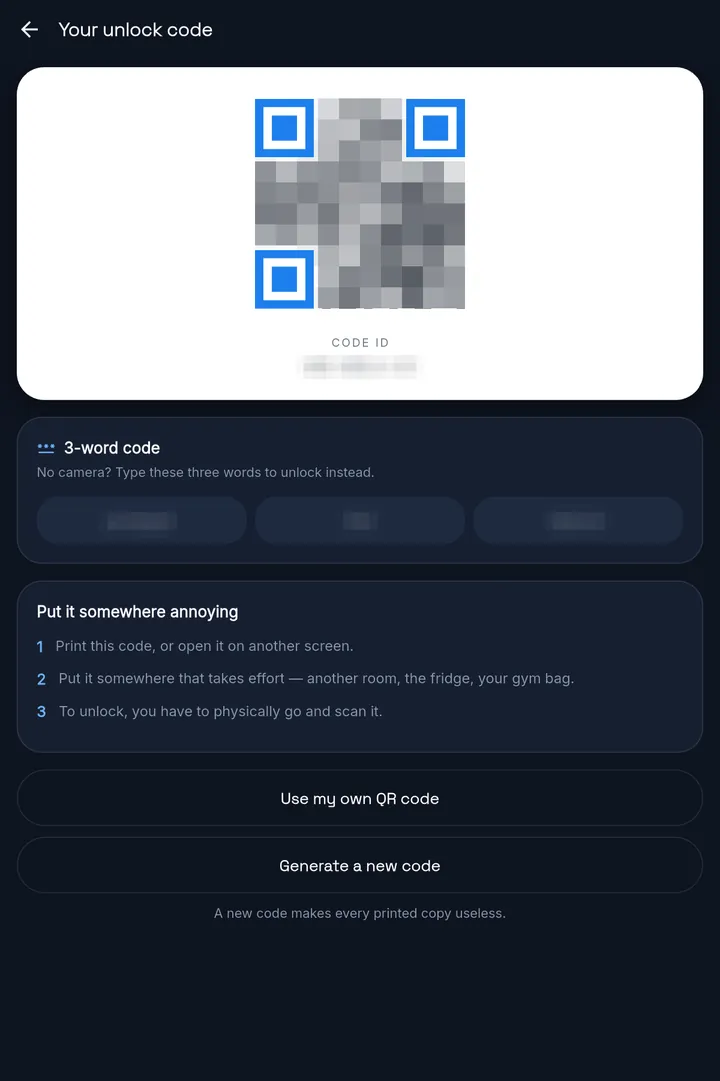
FreePrint the app's code, or open it on another screen, and put it somewhere that takes effort: another room, a drawer, your bag. Or enrol any QR code you already own, such as a sticker or a loyalty card with a QR code. It replaces the app's code. Codes are reusable. Generate a new code and every old printout stops working.
Waits for your minimum lock time? Yes
3-word code
ProThree words that belong to your QR code. No camera? Type them instead. Turn on “Unlock without camera” to use it. The words are also shown in the app, so they add a wait, not a hidden key. Strict mode switches them off.
Waits for your minimum lock time? Yes
NFC tag
ProEnrol a tag, stick it somewhere out of the way, and tap it to unlock. The walk to the tag is the friction. With auto-relock on, each re-lock waits again before the tag works.
Waits for your minimum lock time? Not for the first unlock
Charging cable
ProChoose the charger as your key. Your apps stay locked until you plug in and tap Unlock, which ends the lock. No timer. Keep the charger in another room. A power bank counts as a charger too, so this works best if you don't carry one.
Waits for your minimum lock time? No
PIN
ProA PIN opens a lock you started, straight away. With strict mode on, MassBlocker's settings and ending a session also need it, and the app's own QR code and its 3-word code are switched off. A QR you enrolled yourself still works. So does an NFC tag or charger key. A PIN works best when someone else keeps it: a flatmate, a partner or a friend.
Waits for your minimum lock time? No
No NFC on your phone? Use a QR code (Free) or your charger (Pro). See what each plan costs on the pricing page.
Set a minimum lock time
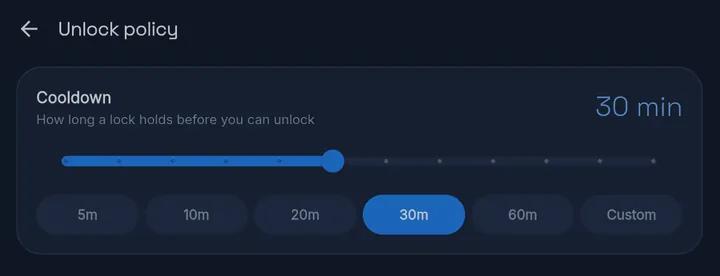
When you tap Lock now, a minimum lock time starts (the app calls it the cooldown). It counts from the moment you lock, not from when you start wanting the app back. Until it is over, a QR scan or 3-word code won't open anything, and the lock screen has no button to skip it, unless you set a PIN, which opens it early.
The point is the gap. By the time the lock time is over and you have walked to your code, you get to decide again, calmly.
- On Free, choose from presets up to an hour. With Pro, set any length from 1 to 600 minutes. Pro
- Charging unlocks (Pro) never wait: plug in, then tap Unlock. An NFC tag (Pro) skips the wait for the first unlock. With auto-relock on, each re-lock waits again.
- It applies to locks you start with Lock now. Profiles and schedules don't use it.
- The Free plan has a daily limit on lock sessions. It counts the locks you start, not your unlocks. Pro removes the limit.
If you've set a PIN (Pro), the lock screen also shows “Use PIN”, and whoever knows it can open your apps early. That's why we suggest someone else keeps it.
Add a schedule
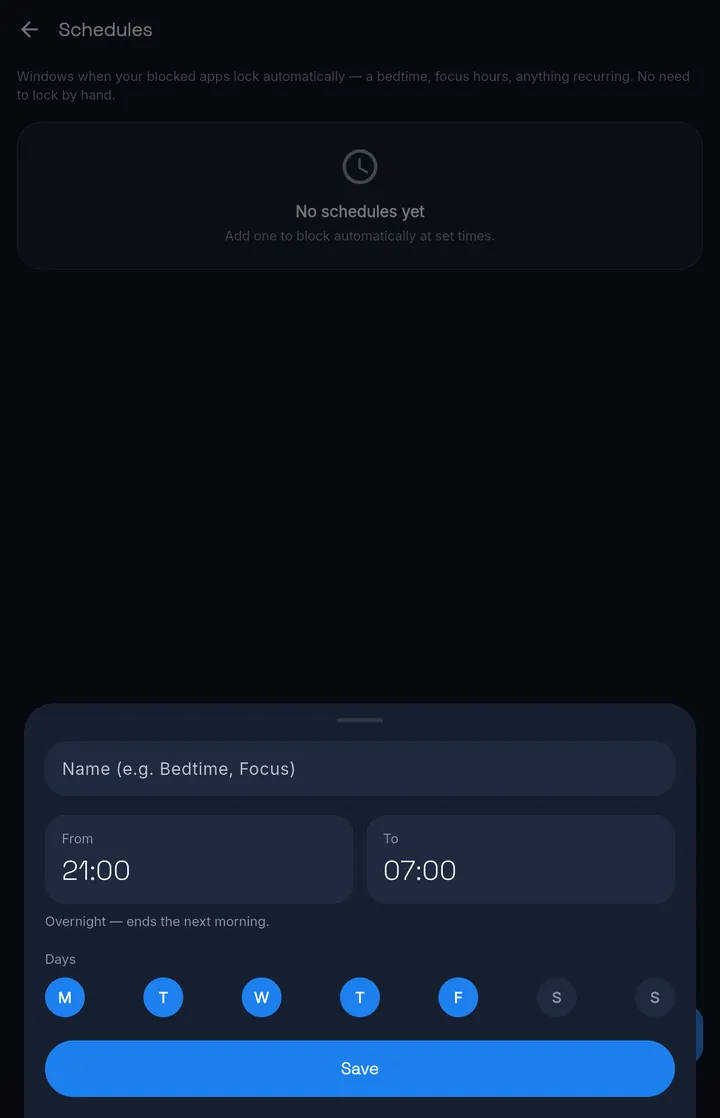
Starting a lock by hand works until the evening you decide not to. A schedule removes that decision: you set a window once, and your blocked apps lock themselves inside it. Schedules are free.
Name it, set the times and pick the days. An overnight window, such as 11 pm to 7 am, carries past midnight and ends the next morning. Study hours might be 9 am to 6 pm on weekdays. Nothing on the lock screen ends a window early; your apps open again when it ends.
Profiles go one step further: a set of apps with its own hours and its own way to unlock, either Scan, Charging, NFC or Hard block (PIN only). A profile's key opens its apps straight away. With set hours, they stay open until the hours end; without, they lock again after the profile's open window. Free includes one profile, in Scan mode. With Pro, run as many as you like, in any mode: say, a Charging profile for work hours and a Hard block profile overnight.
Auto-relock Pro (the app calls it Recurring cycles) covers the quick check. It's on by default with Pro and the trial, and you can turn it off. After you unlock, your apps stay open for a usage window you choose, then lock again, and the minimum lock time runs again.
Make the lock harder to undo (Pro)
The last step closes the easy exits. On Free, or on Pro with strict mode off, you can still edit your blocklist, schedules and profiles during a lock. On Pro, changing the unlock method ends the lock.
Strict mode puts MassBlocker's settings, and ending a session, behind a PIN. In strict mode, the app's own QR code and its 3-word code are switched off. Your PIN, or a QR you enrolled yourself, still works. So does an NFC tag or charger key. Set the PIN, then give it to someone you live with.
Uninstall protection blocks the quick uninstall. It uses Android's Device Admin feature. Turning it off inside MassBlocker needs your PIN. It can still be switched off in Android Settings.
The honest limit
Strict mode is a strong deterrent, not an unbreakable jail — on stock Android a determined user can disable the service.
If blocking gets switched off, MassBlocker shows a banner on its home screen. Nobody else is alerted.
The full setup, and what it can and can't do, is in how to make your blocker hard to uninstall.
FAQ
Questions
Does blocking work without root?
Yes. MassBlocker relies on one permission: the accessibility service, which you grant in Settings. No root, no unlocked bootloader and no ADB commands are needed.
Will it drain my battery?
MassBlocker's blocking service is event-driven. It wakes when Android reports that a different app window has opened, checks that app against your list, and goes back to waiting. It does not read the screen or scan in a loop.
Can I still get calls?
Yes. Only the apps you choose to block are locked. Calls, messages, alarms, maps and every app you leave off the list work as normal.
Can I block apps for free?
Yes. The Free plan locks the apps you choose, with QR code unlocks, schedules, Gentle Nudge, one profile and a daily limit on lock sessions. It needs no account and has no ads. Pro adds unlimited locks, NFC, charging and 3-word unlocks, unlimited profiles, auto-relock, strict mode and uninstall protection. Family adds a group of up to 5 people.
What happens if I switch the blocker off in Settings?
Blocking stops. On stock Android, the phone's owner can turn any accessibility service off in Settings, and MassBlocker is no exception. If that happens, MassBlocker shows a banner on its home screen: "Blocking is switched off", or during a lock, "A lock is running but not enforced". No other alert is sent. Strict mode is a strong deterrent, not an unbreakable jail — on stock Android a determined user can disable the service.
Does it block websites, Reels or Shorts?
No. MassBlocker blocks whole apps. It doesn't block websites, single features inside an app such as Reels or Shorts, or notifications.
Android · Free on Google Play
MassBlocker, the app in this guide
MassBlocker does all of the above on Android: pick the apps, choose how they unlock, and set a minimum lock time and a schedule. Strict mode and uninstall protection (Pro) close the easy exits.
(opens in a new tab)No ads.
Try Pro free for 7 days — no card. Sign in to start.
See everything MassBlocker doesKeep reading
Related guides
- Make your blocker hard to uninstallProUninstall protection, strict mode and a PIN someone else keeps, with the honest limits.Read the guide
- Block apps with an NFC tagProEnrol a tag, stick it out of reach, and tap to unlock.Read the guide
- A phone lock for study hoursA study-hours schedule that locks feeds and games while you work.Read the guide